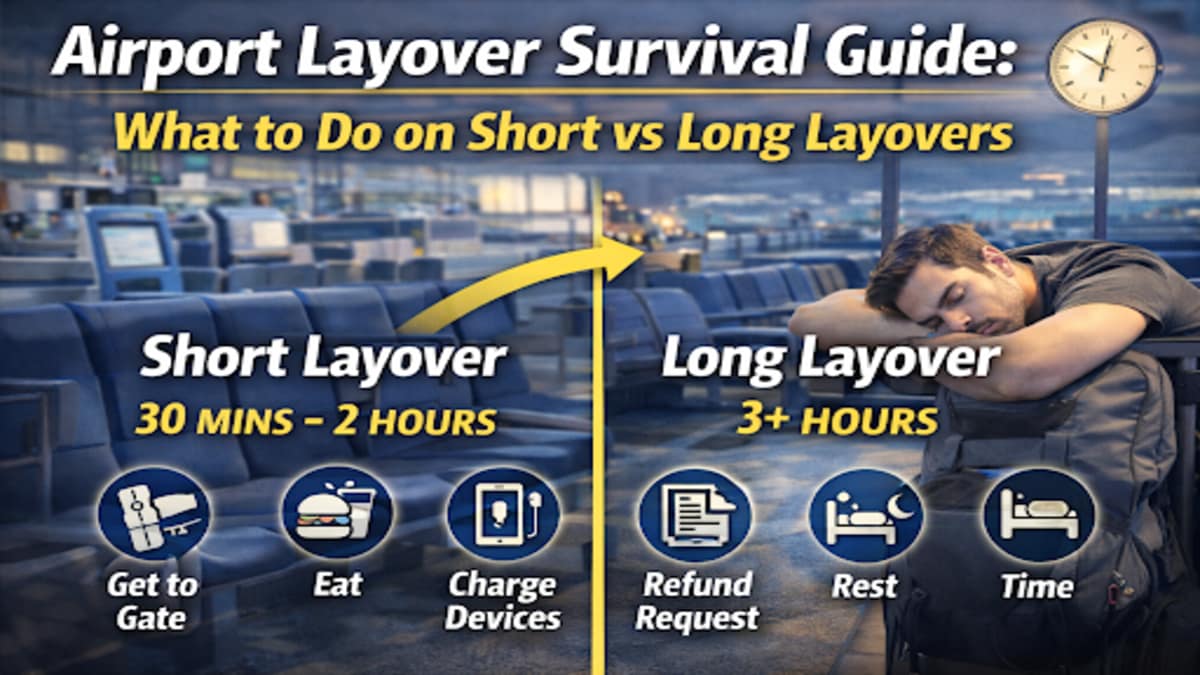
Layovers are not the problem, uncertainty is
An airport layover can be either a smooth, boring pause between flights or an absolute mess that drains your energy before you even reach your destination. The difference usually is not the airport itself. It is whether you know what you are doing.
Most layover stress comes from three questions people do not answer early enough:
- Do I have enough time to make this connection, realistically?
- What should I do first so I do not miss my next flight?
- How do I stay comfortable if the layover is long, late, or overnight?
This guide is designed to make your layovers predictable. Whether you have 35 minutes to sprint or seven hours to kill, you will know what to prioritize, what to ignore, and how to avoid the classic mistakes that turn a normal connection into chaos.
We will cover the practical meaning of minimum connection time, how to plan your layover around real airport flow, how to upgrade your comfort through airport lounge access without wasting money, how to survive long waits without feeling gross, and the best overnight layover tips when your “short connection” suddenly turns into a late-night reality.
We will also clear up transit vs stopover, because that one detail can decide whether you can leave the airport and whether you need to worry about visas, baggage, or re-checking.
If you fly even a few times a year, getting good at layovers is one of the most useful travel skills you can build.
First, know what kind of layover you actually have
Not all layovers are created equal. The airport experience changes depending on your ticket type, your route, and whether you are protected by the airline.
Protected connection vs self-transfer
A protected connection usually means your flights are on one booking and the airline has responsibility to get you to your destination if something goes wrong. If the first flight is late and you miss the second, they normally rebook you. It can still be painful, but you are not alone.
A self-transfer means you stitched together flights yourself, often on separate bookings. That can save money, but it shifts the risk onto you. If you miss the second flight, you might be treated like a no-show and you may have to buy a new ticket.
This matters because when you choose how tight a connection can be, you are really choosing how much risk you are willing to carry.
Domestic-to-domestic, international-to-international, and mixed

Connections that stay domestic often move faster. Mixed connections, especially international arrivals connecting to another flight, can be slower because you may need to clear immigration, pick up bags, re-check, or go through security again depending on the airport and route.
When people underestimate layovers, it is usually because they assume every connection works like a simple domestic transfer. It does not.
Same terminal vs terminal change
Some airports are basically one building. Others are multiple terminals connected by trains, buses, or long walks. A terminal change can add 20 to 60 minutes of hidden time depending on the layout, crowds, and transport frequency.
If you have a short layover and a terminal change, treat it seriously.
The real meaning of minimum connection time
Airlines and airports publish something called minimum connection time. It sounds like a guarantee, but it is better understood as “the shortest connection the system will sell under ideal conditions.”
It does not mean you will be comfortable. It does not mean you will have time to use the bathroom. It does not mean you will have time to eat. It often means you will make it if everything is on time, you move quickly, and you do not get stuck in lines.
Here is how to use minimum connection time like a smart traveler:
- If your itinerary is close to the minimum, you should act like you are on a tight schedule from the moment you land.
- If you are traveling with kids, mobility needs, or lots of carry-on luggage, add buffer time beyond the minimum.
- If you are landing from an international flight and connecting to another international flight, add buffer time because immigration and security variability can be brutal.
- If you are doing a self-transfer, the minimum is not your friend. You want extra time, because nobody is protecting your connection.
A simple mental model that helps: minimum connection time is what works on a calm day. Your plan should work on an average day.
The golden rule: your layover clock starts at arrival, but your connection starts at the gate
People count layover time from the scheduled arrival to the scheduled departure. In reality, you need to subtract a bunch of time you do not control:
- Taxi time after landing can be 5 to 20 minutes.
- Getting off the plane can be 5 to 15 minutes depending on your seat and crowd.
- Walking to your next gate can be 5 to 30 minutes, sometimes more.
- Security or immigration can destroy your timing if you must go through them.
- Boarding usually starts earlier than departure, and doors often close before departure.
So when you “have a two-hour layover,” what you often have is maybe 70 to 90 minutes of usable time, sometimes less.
This is why you should think in two phases:
- Phase one: make the connection safe.
- Phase two: use the remaining time for comfort.
Short layovers: 35 to 75 minutes
Short layovers can be totally fine if you behave like a professional about it. The goal is not to do a lot. The goal is to remove the risk of missing your flight.
Step 1: before you land, get your next gate and backup plan
If you can, check your next gate before you land. Gates change, but having a starting point helps. As soon as you get signal, refresh the information again.
Also, check your boarding time. Some people miss flights because they aim for “departure” and forget boarding closes earlier.
Step 2: move with purpose, not panic
The ideal short layover pace is fast and calm. You do not want to sprint if you do not have to, but you also do not want to wander.
Walk directly toward your gate area first. If you arrive and you have time, then you can make comfort decisions.

Step 3: do not stop for food until you know you are safe
This is the biggest short layover mistake. People stop for coffee because they feel like they “deserve it,” then the line is long, the gate is far, and suddenly it is boarding.
If you are hungry, buy something fast, like a bottled drink and a snack that takes ten seconds. Save real meals for longer layovers.
Step 4: if you are tight, ask for help the right way
If you land late and you know it is close, do not argue with strangers about aisle access. Keep it simple. When the seatbelt sign is off, move quickly. If you have a protected connection, you can also tell cabin crew you have a tight connection. They sometimes help by letting tight-connection passengers move first.
It is not guaranteed, but it can help.
Step 5: if you missed it, switch mental modes immediately
If you miss a flight on a protected connection, your job changes. Stop running. Go straight to the airline desk, help counter, or rebooking area. If the line is huge, call the airline while you stand in line. Use the app if it allows self-rebooking.
If you are self-transfer, you need to make a fast decision about whether you can get on a later flight with the same airline or whether you need a new plan.
Short layover success is mostly about discipline. When you treat the connection like a mission first, you stop losing time to small distractions.
Medium layovers: 75 minutes to 3 hours

This is the sweet spot for many travelers. You have enough time to breathe, eat, and reset, but you still need to stay organized.
Your best move: “gate first, comfort second”
Even with a medium layover, go to your next gate area early, at least enough to confirm where it is and how far it feels. Then you can choose food, rest, or shopping without feeling that anxious “what if I’m at the wrong place” pressure.
Food strategy that does not backfire
Airports trick you into either overspending on bad food or wasting time hunting for something “worth it.” The practical move is to choose a place that is close enough to your gate that you can return quickly.
Eat earlier than you think. If you wait until the last 30 minutes, you are competing with boarding, gate changes, and last-minute crowd chaos.
Recharge strategy: small actions that change your mood
Medium layovers are a perfect time to do a quick reset that makes the rest of the journey easier:
- Wash your face and hands.
- Brush your teeth.
- Refill your water bottle.
- Do a two-minute stretch near a quiet corner.
Those little actions can make you feel human again, which matters more than people admit.
Work strategy: be careful with the “I’ll get so much done”
Airports are distracting. Wi-Fi can be unreliable. Seating can be uncomfortable. If you need to work, pick one focused task, not a full plan.
A simple approach: 30 to 45 minutes of focused work, then stop. Do not burn your brain before your next flight.
Long layovers: 3 to 7 hours
A long airport layover can actually be useful if you treat it like a mini day plan, not dead time.
Decide early: stay in the terminal or leave the airport
This is where transit vs stopover becomes important.
A transit connection usually implies you are passing through on the way to somewhere else, often without leaving the secure area if the airport allows it.
A stopover is typically a longer planned break, sometimes a day or more, and it often implies you will leave the airport and possibly enter the country.
In real life, travelers use “stopover” to describe any long layover where you might leave the airport. But airports and immigration systems care about whether you are actually entering the country.
Before you decide to leave, you need to know:
- Do you have the right to enter the country, visa-wise?
- Will you need to clear immigration even if you stay in the airport?
- Do you have checked bags that will be held, or will you need to pick them up?
- How long will it take to get back through security and to your gate?
If you cannot answer those, staying in the airport is usually the safer choice.
If you stay, build a comfort routine

Long layovers drain you because you sit in weird positions and snack badly for hours. Your goal is to create structure:
- First hour: food, water, restroom, regroup.
- Second hour: movement, stretch, find your “base spot.”
- Third hour: rest or work, depending on your energy.
- Later: check gate status, then repeat small comfort steps.
It sounds simple, but a plan prevents the “I just wandered for four hours and now I’m exhausted” outcome.
Airport lounge access can be worth it, but only in the right situations
People either ignore lounges or treat them like a luxury they do not deserve. In reality, airport lounge access is a tool. Sometimes it is not worth it. Sometimes it saves your entire day.
It tends to be worth it when:
- You have a 3+ hour layover and you want a quiet space.
- You need reliable Wi-Fi and charging.
- You want food that is less chaotic than the terminal.
- You need a shower or a calmer restroom experience.
- Your alternative is buying multiple overpriced meals and drinks anyway.
It tends to be less worth it when:
- Your layover is short.
- The lounge is crowded.
- You are traveling with a big group and the cost multiplies.
- You do not plan to eat or rest, and you just want to move on.
The best way to think about airport lounge access is this: you are buying calm and predictability. If you need that, it is money well spent.
How to get lounge access without overpaying

There are a few common paths people use:
- Access included with a premium cabin ticket.
- Access through airline status.
- Access through certain credit card benefits or lounge memberships.
- Day passes or paid entry at the door, when available.
If you are a frequent flyer, a membership or a card benefit can make sense. If you fly a few times a year, paying for a single entry during a brutal long layover can still be worth it if it replaces multiple meals and gives you a quiet place to recharge.
Very long layovers: 7 to 12 hours
This is where you start feeling like you are living at the airport, and your strategy should change.
The biggest decision is sleep vs movement
If you have an early next flight, sleep becomes a priority. If you have a daytime layover, movement can keep you from feeling stiff and miserable.
You do not want to do nothing for 10 hours. Your body will hate you for it.
Find a proper “rest spot”
Many airports have quiet zones, rest areas, or less busy gates. Sometimes the best place is not the obvious central seating area. It is a quieter corridor with fewer flights, or a higher level away from crowds.
When you find a decent spot, claim it. Charge your devices. Organize your bags. Make that your base so you are not constantly moving.

Food becomes a planning problem
At 10 hours, you will eat more than once. If you just snack randomly, you will feel awful. Try to eat one proper meal, then one lighter meal later. Hydrate. It sounds basic, but it directly affects how you feel on the next flight.
Hygiene matters more than you think
On a long layover, quick hygiene resets change your mood. Wash up. Change socks. Refresh your face. Brush teeth. If you have access to a shower through airport lounge access or airport facilities, it can feel like a full reboot.
Overnight layovers: when your layover becomes a survival situation
An overnight airport layover is where people make the most expensive mistakes because they are tired and reactive. This is where overnight layover tips truly pay off.
Step 1: confirm whether you should sleep in the airport or get a hotel
Do not automatically assume you must sleep on a chair. Sometimes a hotel is the smartest move, especially if:
- You have a very long overnight gap.
- You can get a hotel voucher from the airline due to a controllable disruption.
- You have an early morning flight and need real sleep.
- You are traveling with kids or elderly family.
Sometimes sleeping at the airport is fine if:
- The gap is short, like 5 to 7 hours.
- The airport is known to be safe and open overnight.
- Hotels are far, expensive, or slow to reach.
The key is not comfort alone. It is risk. If leaving the airport puts your connection at risk due to security lines or transport uncertainty, staying might be safer.
Step 2: if the airline caused the disruption, ask about accommodation
If your overnight situation is due to a cancellation or long delay, ask the airline what support they provide. Some situations qualify for hotel and transport assistance. It varies by airline and region, but it is always worth asking calmly.
If they do not provide it, keep receipts for reasonable expenses if you need to purchase essentials.
Step 3: pack for the possibility of sleeping anywhere
Here are the core overnight layover tips that experienced flyers use without turning their bag into a camping kit:
- Bring a small eye mask if you can.
- Bring earplugs or noise-cancelling earbuds.
- Bring a light layer, like a hoodie, because airports get cold at night.
- Keep a small toothbrush and travel toothpaste in your personal item.
- Keep a power bank charged.
- Keep a snack and a water plan because many airport shops close overnight.
You do not need a full travel pillow setup. You just need a few small items that make an uncomfortable situation manageable.
Step 4: safety and positioning
If you sleep in an airport, choose a spot that feels safe and practical:
- Stay in a well-lit area with some foot traffic but not constant chaos.
- Avoid isolated corners where you cannot see what is happening.
- Keep valuables on your body or secured.
- If you can, anchor a strap around your leg or arm so your bag cannot be pulled easily.
This is not about paranoia. It is about not being an easy target while you are half asleep.
Step 5: set alarms and plan the morning
Overnight layovers feel disorienting because time gets weird. Set multiple alarms. Plan what time you will move to your gate area. Assume morning security can be busy.
The biggest overnight mistake is waking up late and trying to sprint through a packed security line with no buffer.
The difference between transit vs stopover in real-world decisions
People talk about “I have a layover” like it is one category. Airports treat it differently depending on whether you are transiting within the secure system or entering the country.
Here is a clean way to think about transit vs stopover:
Transit usually means you are staying in the airport system and continuing onward. Your biggest concerns are connection time, gate location, and whether you must clear security or immigration during the transfer.
Stopover usually means you have enough time that leaving the airport is realistic, and it may be intentionally booked that way. Your concerns become entry requirements, baggage handling, and building enough buffer to return.
If you are considering leaving the airport during a long layover, ask yourself:
- Do I have enough time to leave, enjoy something, and return without rushing?
- Do I understand whether I need to clear immigration to do this?
- Do I know if my checked bag is being transferred or if I must pick it up?
- Do I have a safe buffer for security on the way back?
A practical rule many experienced travelers use: if you are not extremely familiar with the airport and the entry process, leaving is usually only worth it if the layover is comfortably long. If it is borderline, stay and focus on comfort inside the airport.
What to do if your layover is suddenly disrupted by delays or gate changes
Layovers often change because the first flight is late, the next flight is moved, or the gate shifts across the terminal.
Here is how to stay in control:
- Check your next flight status as soon as you land.
- Check again after 10 minutes, because gates update.
- Do not wander far from a point where you can quickly return.
- If your gate changes, re-evaluate your food and rest plans.
Also, if you have a tight connection and you think you will miss it, start planning early. If you are on a protected connection, open the airline app and look at alternate flights before you even arrive.
Sometimes you can rebook faster than the line at the desk. If you have checked bags and you are rebooked, confirm whether your bags will follow the new itinerary.
This is where calm preparation beats panic every time.
Layover comfort: a checklist that works in almost every airport

You can make almost any airport layover better with the same five comfort moves. They are simple, but they work:
- Hydrate early. Airports dehydrate you without you noticing.
- Eat intentionally. One proper meal beats five random snacks.
- Move your body. Walk, stretch, loosen your hips and calves.
- Reset hygiene. Wash face, brush teeth, change socks if you can.
- Charge everything. Do not wait until you are at 12 percent battery.
These are not fancy hacks. They are the basics that keep you from feeling wrecked on arrival.
Traveling with kids: layovers need a different plan
If you are traveling with children, the layover is not “time to chill.” It is a management task.
The biggest goal is preventing meltdown energy from building up.
Use the layover for:
- Bathroom before the next flight, even if nobody “needs” it yet.
- Food at a predictable time. Hungry kids are chaos.
- Movement. Walk, explore, let them change scenery.
- Quiet time. A show, a book, or a calm corner before boarding.
Also, do not plan a tight connection with kids unless you have no choice. Minimum connection time might be technically possible, but the stress is not worth it.
Traveling with elderly family or mobility needs
Give yourself more buffer than you think you need. Wheelchair assistance can be amazing, but it can also involve waits. Elevators can be crowded. Distances can be longer than expected.
If you need assistance, request it early, ideally when booking or as soon as possible. On travel day, confirm it again.
A calm connection is more important than saving 20 minutes on paper.
The “airport shopping trap” and how to avoid it
Long layovers can turn into mindless spending, partly because you are bored and partly because the environment is designed to sell.
If you want to avoid that:
- Set a budget before you start browsing.
- Buy essentials first, like water, then stop.
- Use shopping only after you have confirmed your gate and timing.
Shopping should be dessert, not the main course.
How to choose a seat strategy for layover days
Layovers are not only about the airport. Your seat choices on the flights can change your layover experience.
If you have a tight connection, sitting closer to the front can save time getting off the plane. That can be the difference between jogging calmly and sprinting in panic.
If you have a long layover and you want to rest, a seat that allows you to deplane without stress still helps because it reduces your mental load.
This is not a rule that you must always pay for a seat. It is just something to consider when you are booking a tight itinerary.
What to pack in your personal item for better layovers

Layover comfort is often decided by what you can access quickly, not what you packed overall.
A strong layover personal item setup includes:
- Chargers and a power bank.
- A light layer for cold terminals.
- Basic hygiene items.
- Any medication you might need.
- A snack that will not crumble into your bag.
- A pen, because airports still love paper forms in some places.
This is also where overnight layover tips become practical. If you carry a small kit that supports an unexpected night, you stop fearing disruption.
When leaving the airport during a layover makes sense
Leaving the airport can be a great move if you have time and the situation fits. It can turn a boring layover into a mini adventure.
It makes the most sense when:
- Your layover is long enough that you can leave and return with a serious buffer.
- You are confident about entry requirements.
- You are not worried about baggage handling.
- The city is close and transport is reliable.
It makes less sense when:
- Your next flight is early morning and security lines could be unpredictable.
- The airport is far from anything.
- You are exhausted and need rest more than sightseeing.
- You have a tight connection dressed up as a “long layover” because of terminal complexity.
This is why understanding transit vs stopover matters. It is not just vocabulary. It is the difference between “I can leave” and “I should stay.”
How to handle the emotional side of long layovers
A long layover can feel like wasted time. That mindset makes it worse.
A better mindset is: the layover is part of the trip, so I will use it intentionally.
Use it for something that supports your arrival:
- Rest so you are not destroyed at destination.
- Work so you are not stressed later.
- Eat properly so you are not hungry mid-flight.
- Move so your body feels better.
- Reset hygiene so you feel confident.
When you treat the layover as an investment in your next flight, it stops feeling like punishment.
Common layover mistakes that create drama
Let’s call these out because they are avoidable:
- Trusting the published layover time without accounting for walking, lines, and boarding.
- Ignoring minimum connection time reality and booking a self-transfer with a tight gap.
- Stopping for food before confirming your gate on a short layover.
- Leaving the airport without a return buffer and then rushing through security.
- Not charging devices early and then hunting for outlets at the worst time.
- Not packing essentials in the personal item and then being forced to gate-check a carry-on.
- Not planning for an overnight situation and then being stuck without basic comfort items.
Most layover chaos is not bad luck. It is small planning gaps that stack up.
A simple layover plan you can reuse forever
Here is a repeatable routine that works in almost any airport, for almost any airport layover:
- First, confirm next flight status, gate, and boarding time.
- Second, walk toward the gate area and mentally map the route.
- Third, decide how much “free time” you truly have after subtracting a safety buffer.
- Fourth, use free time for food, movement, hygiene, and charging, in that order.
- Fifth, return to the gate area early enough that a last-minute change does not hurt you.
That routine is boring, and boring is exactly what you want at an airport.
FAQs
How do I know if my minimum connection time is enough?
If your itinerary is close to minimum connection time, treat it as a tight connection and move quickly. If it includes immigration, security, or a terminal change, you should be cautious. For self-transfers, you should add extra buffer beyond the minimum because you are carrying the risk.
Is airport lounge access worth it for a long layover?
Airport lounge access is worth it when it buys you calm, reliable seating, charging, quieter space, food, and sometimes showers. If your alternative is spending a lot on terminal food and still feeling uncomfortable, a lounge can be a smart upgrade.
What are the best overnight layover tips if I get stuck?
The best overnight layover tips are: decide early whether to get a hotel, ask the airline about accommodation if the disruption is on them, choose a safe well-lit rest spot if staying in the airport, keep valuables secured, and set multiple alarms so you do not miss your next flight.
What is the difference between transit vs stopover?
Transit vs stopover is mainly about whether you are simply passing through the airport system quickly or whether you have enough time and intent to treat the connection like a break that may involve entering the country. The difference affects whether you can leave the airport, what entry rules apply, and how you should plan your buffer time.
Should I leave the airport during a long layover?
Only if you have enough time to leave and return with a strong buffer, you are confident about entry requirements, and you understand baggage handling. If anything feels uncertain, staying in the airport and using comfort routines is often the safer choice.
Final word
A good airport layover is not about luck. It is about a simple system: respect minimum connection time, secure your connection first, then use your time for comfort, and lean on tools like airport lounge access when it genuinely improves your day. If things go wrong, overnight layover tips keep you calm and functional.
And if you are debating leaving the terminal, understanding transit vs stopover helps you make the decision without guessing.

Hi, I’m Bruno. I’ve worked in the aviation industry for over 6 years as a B1.1 Licensed Aircraft Maintenance Engineer. This blog is where I share insights on aviation and travel globally.