


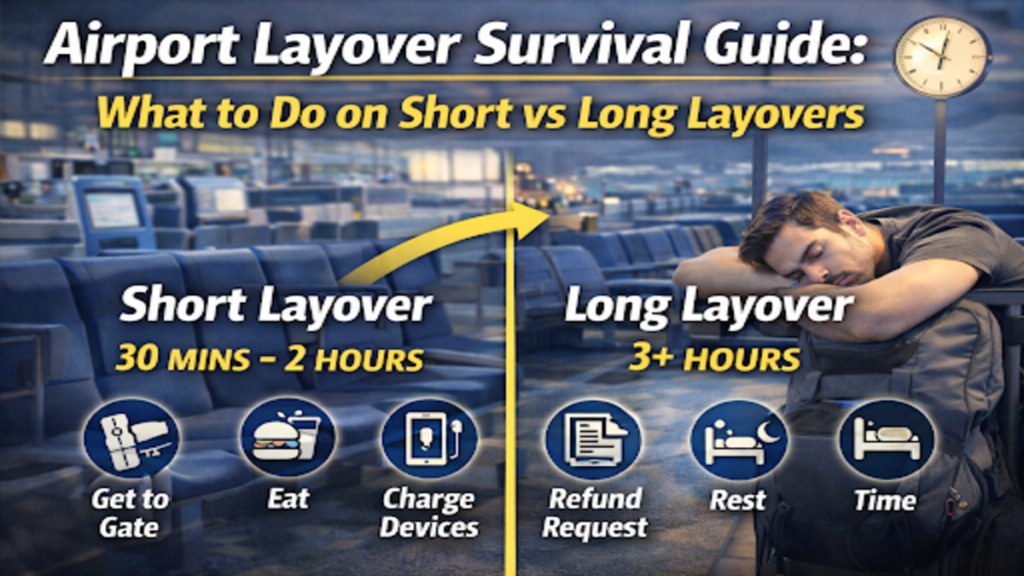
Layovers are not the problem, uncertainty is
An airport layover can be either a smooth, boring pause between flights or an absolute mess that drains your energy before you even reach your destination. The difference usually is not the airport itself. It is whether you know what you are doing.
Most layover stress comes from three questions people do not answer early enough:
- Do I have enough time to make this connection, realistically?
- What should I do first so I do not miss my next flight?
- How do I stay comfortable if the layover is long, late, or overnight?
This guide is designed to make your layovers predictable. Whether you have 35 minutes to sprint or seven hours to kill, you will know what to prioritize, what to ignore, and how to avoid the classic mistakes that turn a normal connection into chaos.
We will cover the practical meaning of minimum connection time, how to plan your layover around real airport flow, how to upgrade your comfort through airport lounge access without wasting money, how to survive long waits without feeling gross, and the best overnight layover tips when your “short connection” suddenly turns into a late-night reality.
We will also clear up transit vs stopover, because that one detail can decide whether you can leave the airport and whether you need to worry about visas, baggage, or re-checking.
If you fly even a few times a year, getting good at layovers is one of the most useful travel skills you can build.
First, know what kind of layover you actually have
Not all layovers are created equal. The airport experience changes depending on your ticket type, your route, and whether you are protected by the airline.
Protected connection vs self-transfer
A protected connection usually means your flights are on one booking and the airline has responsibility to get you to your destination if something goes wrong. If the first flight is late and you miss the second, they normally rebook you. It can still be painful, but you are not alone.
A self-transfer means you stitched together flights yourself, often on separate bookings. That can save money, but it shifts the risk onto you. If you miss the second flight, you might be treated like a no-show and you may have to buy a new ticket.
This matters because when you choose how tight a connection can be, you are really choosing how much risk you are willing to carry.
Domestic-to-domestic, international-to-international, and mixed


Connections that stay domestic often move faster. Mixed connections, especially international arrivals connecting to another flight, can be slower because you may need to clear immigration, pick up bags, re-check, or go through security again depending on the airport and route.
When people underestimate layovers, it is usually because they assume every connection works like a simple domestic transfer. It does not.
Same terminal vs terminal change
Some airports are basically one building. Others are multiple terminals connected by trains, buses, or long walks. A terminal change can add 20 to 60 minutes of hidden time depending on the layout, crowds, and transport frequency.
If you have a short layover and a terminal change, treat it seriously.
The real meaning of minimum connection time
Airlines and airports publish something called minimum connection time. It sounds like a guarantee, but it is better understood as “the shortest connection the system will sell under ideal conditions.”
It does not mean you will be comfortable. It does not mean you will have time to use the bathroom. It does not mean you will have time to eat. It often means you will make it if everything is on time, you move quickly, and you do not get stuck in lines.
Here is how to use minimum connection time like a smart traveler:
- If your itinerary is close to the minimum, you should act like you are on a tight schedule from the moment you land.
- If you are traveling with kids, mobility needs, or lots of carry-on luggage, add buffer time beyond the minimum.
- If you are landing from an international flight and connecting to another international flight, add buffer time because immigration and security variability can be brutal.
- If you are doing a self-transfer, the minimum is not your friend. You want extra time, because nobody is protecting your connection.
A simple mental model that helps: minimum connection time is what works on a calm day. Your plan should work on an average day.
The golden rule: your layover clock starts at arrival, but your connection starts at the gate

People count layover time from the scheduled arrival to the scheduled departure. In reality, you need to subtract a bunch of time you do not control:
- Taxi time after landing can be 5 to 20 minutes.
- Getting off the plane can be 5 to 15 minutes depending on your seat and crowd.
- Walking to your next gate can be 5 to 30 minutes, sometimes more.
- Security or immigration can destroy your timing if you must go through them.
- Boarding usually starts earlier than departure, and doors often close before departure.
So when you “have a two-hour layover,” what you often have is maybe 70 to 90 minutes of usable time, sometimes less.
This is why you should think in two phases:
- Phase one: make the connection safe.
- Phase two: use the remaining time for comfort.
Short layovers: 35 to 75 minutes
Short layovers can be totally fine if you behave like a professional about it. The goal is not to do a lot. The goal is to remove the risk of missing your flight.
Step 1: before you land, get your next gate and backup plan
If you can, check your next gate before you land. Gates change, but having a starting point helps. As soon as you get signal, refresh the information again.
Also, check your boarding time. Some people miss flights because they aim for “departure” and forget boarding closes earlier.
Step 2: move with purpose, not panic
The ideal short layover pace is fast and calm. You do not want to sprint if you do not have to, but you also do not want to wander.
Walk directly toward your gate area first. If you arrive and you have time, then you can make comfort decisions.
[the_ad id=”1034″]
Step 3: do not stop for food until you know you are safe
This is the biggest short layover mistake. People stop for coffee because they feel like they “deserve it,” then the line is long, the gate is far, and suddenly it is boarding.
If you are hungry, buy something fast, like a bottled drink and a snack that takes ten seconds. Save real meals for longer layovers.
Step 4: if you are tight, ask for help the right way
If you land late and you know it is close, do not argue with strangers about aisle access. Keep it simple. When the seatbelt sign is off, move quickly. If you have a protected connection, you can also tell cabin crew you have a tight connection. They sometimes help by letting tight-connection passengers move first.
It is not guaranteed, but it can help.
Step 5: if you missed it, switch mental modes immediately
If you miss a flight on a protected connection, your job changes. Stop running. Go straight to the airline desk, help counter, or rebooking area. If the line is huge, call the airline while you stand in line. Use the app if it allows self-rebooking.
If you are self-transfer, you need to make a fast decision about whether you can get on a later flight with the same airline or whether you need a new plan.
Short layover success is mostly about discipline. When you treat the connection like a mission first, you stop losing time to small distractions.
