Why “carry on size” is more confusing than it should be
If you have ever stood at an airport check-in area watching someone wrestle a bag into a metal sizer, you already know the truth: carry on size is not just a simple measurement. It is a mix of airline policy, aircraft type, how full the flight is, and how strict the staff decide to be that day.
That is why you can fly one route with the same bag five times with zero issues, then on the sixth trip you suddenly get stopped and told you need to pay. It feels random, but there are real patterns behind it.
This guide is built to remove the uncertainty. We are going to cover what carry on luggage dimensions usually look like across airlines, how airline carry on weight limits actually affect you, why personal item size can be the biggest trap on budget fares, and how overhead bin rules work in real life when the plane is full and everyone is trying to squeeze their stuff into the same space.
The goal is simple: you should be able to pack once, confidently, and not get hit with surprise fees or last-minute gate checks.
Start with the two things airlines care about most: space and speed
Airlines want boarding to be fast. They also want the cabin to be safe, with bags secured properly. The fastest boarding happens when bags fit easily into overhead bins and under seats, and when people do not block the aisle trying to force a bag that is too big.
So when an airline enforces carry on size rules, it is not only about being strict. It is often about preventing chaos on a full flight, protecting on-time performance, and avoiding safety problems with bags sticking out or bins that will not close.
Once you see it that way, the rules make more sense.
Carry-on vs personal item: the definition that saves you money
Many travelers use “carry-on” to mean “anything I take on the plane.” Airlines do not.
Most airlines split cabin baggage into two categories:
- A carry-on bag that usually goes in the overhead bin.
- A personal item that usually goes under the seat in front of you.
The important part is this: some fares include both, some include only the personal item size allowance. That one detail is where a lot of “cheap flight” tickets get expensive.
If you buy a basic fare thinking it includes a carry-on, then show up with a roller bag, you may get charged. Sometimes you can pay online to add it. Sometimes you only find out at the airport. Sometimes it becomes a gate fee that costs even more.
If you do nothing else after reading this guide, do this: always confirm whether your ticket includes an overhead-bin carry-on or only a personal item.
The common carry on luggage dimensions you will see most often
Airlines publish exact rules, and those rules vary. Still, there are patterns.
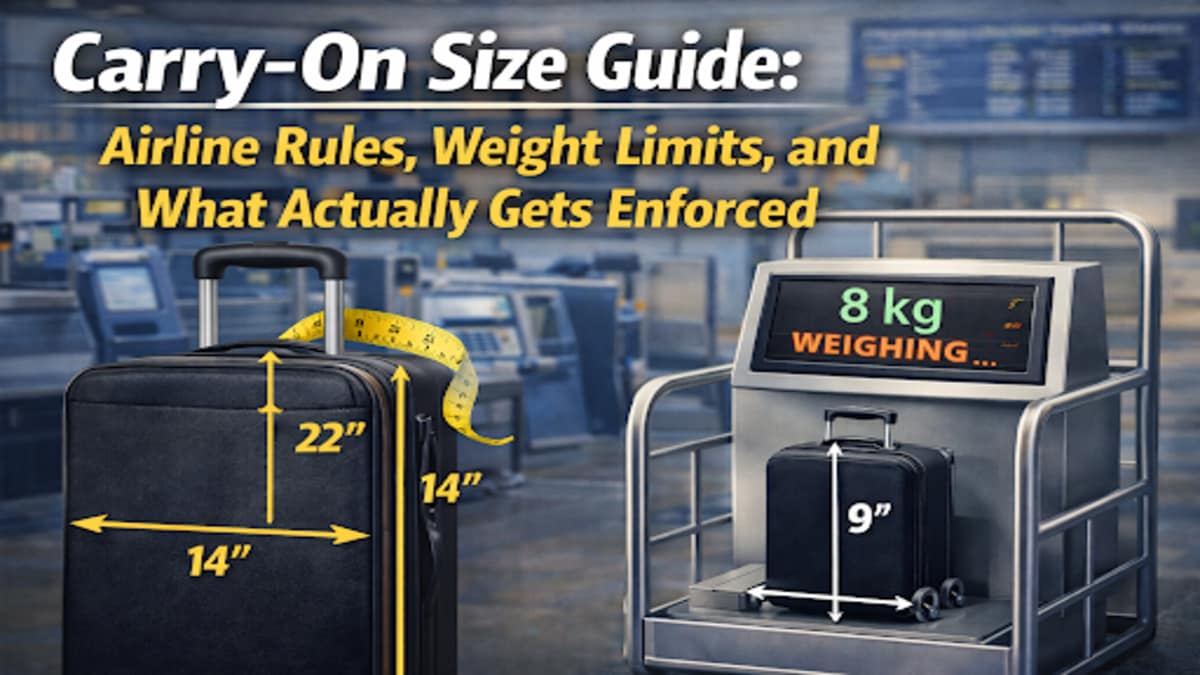
A very common benchmark in many markets is a carry-on limit around 22 x 14 x 9 inches, which is roughly 56 x 36 x 23 cm. You will see slight variations around this. Some airlines allow a bit more. Some allow a bit less. Some include handles and wheels. Some pretend they do not, but then measure them anyway.
That is why the phrase carry on luggage dimensions matters. It is not just length and width. It is the total outer size, including anything that sticks out.
If your bag is right on the edge, wheels and hard corners can be the difference between “fine” and “please place it in the sizer.”
Why soft bags feel easier than hard bags
A soft-sided bag can sometimes “give” a little if it is close to the limit. A hard shell does not. Hard shells protect your stuff better, but they also make size enforcement more binary.
This is one reason frequent flyers often love structured soft carry-ons. They hold shape, but they still have a tiny bit of flexibility when overhead bins are tight or when an airline uses a strict sizer.
Expandable bags can quietly cause problems
Expandable carry-ons are great until you expand them. Then you may cross the allowed carry on luggage dimensions without realizing it.
If you use an expandable bag, treat the “expanded” shape as your real size. If it only fits the rules when it is not expanded, you need enough discipline not to unzip that extra compartment on the way to the airport.
Airline carry on weight limits: the rule that gets ignored until it doesn’t
A lot of travelers assume weight is only for checked bags. Not always.
Some airlines enforce airline carry on weight limits seriously. Others barely mention it. You cannot predict it based on the country alone, but there are trends.
In some regions and on some carriers, staff regularly weigh carry-ons at check-in. This is especially common when:
- The airline has a strict low-cost model.
- The route is known for heavy luggage.
- The aircraft is smaller, which also means smaller bins.
- The flight is very full and the airline expects overhead bin pressure.
If your airline has airline carry on weight limits, you should plan for them like they will be enforced, because the worst time to find out is when you are already at the airport.
The sneaky issue: your bag can be within size but overweight
A carry-on can fit perfectly in the sizer and still be too heavy. This happens a lot with laptops, camera gear, power banks, and dense items like books.
If you carry tech, your bag gets heavy fast. In that case, a good strategy is shifting some weight into your personal item if your fare allows both. The airline usually focuses on whether the bag fits, but if they weigh carry-ons, weight becomes the second gate you have to pass.
Weight limits also affect how easy it is to lift your bag
Even if nobody weighs it, a heavy carry-on is a problem if you cannot lift it comfortably into the bin. Flight attendants are not required to lift your bag. Some will help, some will not, and on a busy flight you do not want to be the person blocking the aisle because you cannot get your bag up.
A practical approach is packing so you can lift your carry-on without strain. If you cannot lift it easily at home, you will struggle more in a narrow aisle with people waiting behind you.
Personal item size: where budget airlines make their money
If there is one rule that catches more people than anything else, it is personal item size.
On many fares, your ticket includes only a personal item. That personal item must fit under the seat in front of you. Airlines often publish exact measurements for it, and on strict carriers they will enforce it.
Here is the catch: lots of people carry a backpack that feels “small enough” but is actually too tall or too thick when fully packed. Under-seat space is not a magic hole. Once your bag is full, it becomes a brick.
Under-seat space is smaller than you think
Under-seat space varies by aircraft and by seat location. Some seats have less space because of seat supports, electronics boxes, or safety equipment under the seat. Bulkhead rows often have no under-seat storage in front of you. Some exit rows also restrict what you can place there.
That means even if your bag matches personal item size rules on paper, certain seats can make it harder.
If you are flying with only a personal item, a safe strategy is choosing a bag that is comfortably within the airline’s personal item dimensions, not barely within.
Your personal item should pack “flat,” not “puffy”
A puffy backpack that sticks out is more likely to get flagged. A flatter bag that stays compact is less likely to attract attention and more likely to slide under the seat.
If you want to maximize space without breaking personal item size, pack with compression. Use packing cubes if you like, but even simple compression and smart folding helps keep the bag’s shape manageable.
Overhead bin rules: what happens when everyone brings a carry-on
Now let’s talk about the real world. Overhead bin rules are simple in theory: carry-ons go up, personal items go down. In practice, the plane fills up and people start bending that rule.
Some passengers put both bags in the overhead bin. Some people put jackets and duty-free bags up there too. Some people board late and find bins full. That is when problems start.
Why boarding group matters
If you board early, you usually get bin space near your seat. If you board late, you may find the bins near your seat are already full. Then you may be forced to place your bag farther away, or you may be asked to gate-check it.
Even if your carry on size is perfectly allowed, you can still lose the bin-space battle if you board late on a full flight.
That is why airlines sell priority boarding and early boarding bundles. It is not only about comfort. It is bin real estate.
The “bin near your seat” myth
Many travelers assume they will place their carry-on above their seat. On a full flight, that is not guaranteed. You may need to place it several rows away.
If you care about quick exit or you have a tight connection, this matters. If your bag is far behind you, you might have to wait for the aisle to clear, walk back, and then push against traffic to exit.
Gate checking is not always a punishment, but it is a risk
Sometimes airlines ask for volunteers to gate-check carry-ons because bins will fill up. Often this is free. Sometimes it is even convenient, because you do not have to lift the bag or fight for space.
But it becomes a problem if:
- You have valuables or fragile items inside.
- You have medication you need during the flight.
- You have a short connection and fear delays getting the bag back.
- You packed essentials like chargers or documents in that bag.
A smart approach is packing as if gate-check could happen. Keep valuables, medication, and anything you cannot risk losing in your personal item.
That way, if the airline enforces overhead bin rules by asking you to gate-check, you are not stressed.
Why aircraft type changes everything
This is where experienced flyers gain an advantage.
A bag that fits fine on a large aircraft might not fit on a smaller one. Regional jets and some narrow-body planes have smaller bins, especially on certain older configurations.
If your itinerary includes a smaller aircraft, you should be extra cautious with carry on luggage dimensions. You might be forced to valet-check your roller bag even if the airline technically allows it, simply because the bins cannot accommodate it.
The regional jet “valet check” reality
On many regional flights, roller bags are tagged at the gate and placed in the cargo hold, then returned to you on the jet bridge at arrival. This is common and usually free. It is not a disaster if you pack correctly.
Again, keep essentials in your personal item so you can handle this smoothly.
Handles, wheels, and “total size”: how airlines measure your bag
Airlines that enforce sizing usually measure the outer dimensions. That means:
- Wheels count.
- Handles count.
- Hard corners count.
- Side pockets that bulge count.
This is why bags marketed as “carry-on compatible” can still fail on strict carriers. The marketing is often based on general standards, not the exact limit of your airline.
If you want fewer problems, buy a bag that is slightly under the most common carry on luggage dimensions, not exactly at the edge.
Inches vs centimeters: don’t get tripped up by conversion
Airlines publish rules in different units. You might see inches on one airline and centimeters on another. It is easy to misread the limit and assume your bag is fine.
A simple habit that saves you is checking your bag’s dimensions in both systems and saving them somewhere, like a note on your phone. Then when you book a flight, you can compare quickly without guessing.
Also remember: when airlines list dimensions, they usually list them as length x width x height, but the orientation may not match how your bag is marketed. Some brands list height first. Others list width first. This creates confusion.
Your job is to compare the three numbers, not the order.
The carry-on checklist that prevents airport surprises
Here is a practical approach that works across most trips.
- First, confirm your fare includes a carry-on or only a personal item. This is the biggest money trap in modern flying.
- Second, confirm the airline’s carry on size and personal item size rules for your specific route, because some carriers vary by region.
- Third, confirm whether the airline has airline carry on weight limits and treat them as real.
- Fourth, look at your aircraft type and assume bins might be smaller on regional segments.
- Fifth, pack essentials in the personal item so a last-minute gate check does not ruin your flight.
If you do those five steps, you are ahead of most travelers.
What “actually gets enforced” at the airport
Let’s talk honestly about enforcement, because this is what you care about.
Enforcement is stricter when the flight is full
If the flight is full, staff are more likely to enforce carry on size and personal item size rules, because overhead space becomes a limited resource.
Enforcement is stricter on low-cost fares
Low-cost carriers often rely on baggage fees. Their process is built around enforcement. They are more likely to use bag sizers, weigh bags, and charge at the gate.
That does not mean they are “bad.” It means you must play by the rules or you will pay.
Enforcement is stricter at certain airports
Some airports and stations are known for stricter gate checks. This can be influenced by local staffing, local management, and how often flights run into bin-space issues.
You cannot always predict it, but you can pack so it does not matter.
Enforcement is stricter when your bag looks obviously large
A bag can be technically within limits but look huge because it is overstuffed. Staff do not have time to debate. If it looks too big, you might get flagged.
This is why keeping your bag shape compact matters as much as the number on paper.
Choosing the right bag for carry-on travel
If you are building a travel setup for frequent flights, bag choice matters.
Rolling carry-ons: easy on your body, risky on strict personal item fares
A roller bag is comfortable for walking through airports, but it is not a personal item. If your fare includes only a personal item, bringing a roller means you will likely pay.
When your fare includes a carry-on, a roller is great. Just keep it within carry on luggage dimensions that are safely under common limits.
Backpacks: flexible, but can get bulky
A backpack can qualify as a carry-on or as a personal item depending on size. The risk is that people fill it until it becomes too tall and too thick.
If you want a backpack that passes as a personal item, pick one designed to stay slim. If you want it as a carry-on, pick one designed around common carry on size limits and do not overpack it.
Duffels: soft and forgiving, but easy to overfill
Duffels can be great because they compress, but they can also become monsters if you pack them heavy. If you use a duffel, keep it structured enough that it holds a compact shape.
Packing strategy for staying within carry on size
Packing is where most people break the rules without realizing it.
Don’t pack “outward”
Outer pockets are the fastest way to violate carry on luggage dimensions. A bag can measure fine empty, then become oversized once you load the front pocket with chargers, toiletries, and snacks.
Pack heavier items toward the center, and keep outer pockets slim.
Use your personal item strategically
If your ticket includes a carry-on plus a personal item, use the personal item for dense heavy items like electronics. This reduces the chance of failing airline carry on weight limits if your airline weighs carry-ons.
It also protects your valuables if you get asked to gate-check your carry-on.
The “airport squeeze” is your enemy
A bag that barely closes at home might not close after you buy water, snacks, and duty-free items. Your bag expands. Then it looks too big.
Leave space for the reality of travel. If you always pack to the limit, you are one impulse purchase away from an oversized bag.
Liquids, batteries, and sharp items: the side rules that affect your carry-on
Even if your bag meets carry on size, security rules can cause delays or force you to repack.
Liquids rules vary by country, but the common theme is small containers and clear presentation. Batteries and power banks often must stay in carry-on baggage, not checked. Sharp items can be confiscated.
The best move is building a routine: keep liquids in an easy-to-reach pouch, keep electronics accessible, and avoid packing anything questionable in your carry-on if you do not want an argument at security.
This is not about fear. It is about speed and calm.
Special situations that catch travelers off guard
Traveling with gifts
Gifts wrapped in boxes can be awkward because they do not compress. If the box pushes your bag beyond carry on luggage dimensions, you might get flagged.
If you are traveling with gifts, pack them in a way that stays flexible, or use a personal item that stays within personal item size.
Suits and formalwear
Garment bags are tricky because airlines treat them differently. Some count them as your carry-on. Some allow them as an additional item in certain cabins. Some fold them and place them in bins. The result is inconsistent.
If you need formalwear, consider packing it inside a carry-on that stays within carry on size and using simple fold techniques to reduce wrinkles.
Musical instruments and sports gear
Small instruments might be allowed as carry-on if they fit the published size. Larger instruments may require special arrangements or purchasing a seat. Sports gear can also be restricted.
If you travel often with special items, you should build a packing system that keeps your main bag safely compliant so you are not dealing with multiple issues at once.
How to avoid gate fees and last-minute stress
Gate fees are the worst because you have no leverage. You are already there, boarding is happening, and the airline holds all the cards.
Here is how to protect yourself:
- Stay comfortably within carry on size limits, not barely within.
- Respect personal item size if your fare is personal-item-only.
- Do not overstuff your bag so it bulges.
- Board earlier when possible, because bin pressure increases enforcement.
- Keep essentials in your personal item in case you are asked to gate-check.
- Know your airline’s airline carry on weight limits and pack like they will weigh.
If you follow those habits, you stop feeling like baggage rules are a lottery.
What to do if your bag is slightly too big
Sometimes you are close. Maybe your bag is compliant empty but not when packed. Or maybe you misjudged.
If you suspect your bag is borderline, your best options are simple:
- Remove bulky items and wear them, like a jacket or hoodie.
- Shift heavy dense items into your personal item if allowed.
- Compress your bag and avoid expanding pockets.
- If you have a strict carrier, pay for the correct baggage allowance online before you arrive at the airport.
- It is usually cheaper than the gate.
Do not argue with staff about a bag that is clearly oversized. It rarely ends well. Your energy is better spent solving the problem quickly.
The calm traveler mindset: pick a bag setup you can reuse
If you want easy travel, the best long-term strategy is building a consistent system:
- One carry-on bag that is safely under common carry on luggage dimensions.
- One personal item that is safely under common personal item size limits.
- A packing routine that keeps your bag shape compact.
- A habit of checking airline carry on weight limits for your carrier and route.
Once you have that, you stop reinventing the wheel every time you fly. You pack faster. You stress less. You avoid fees.
That is the real value. Not just saving money, but saving your mental energy at the airport.
FAQs
What is the standard carry on size?
There is no single global standard, but many airlines use limits close to common benchmarks around 22 x 14 x 9 inches (about 56 x 36 x 23 cm). Always verify your airline’s exact carry on size and carry on luggage dimensions, including wheels and handles.
Do airlines actually weigh carry-ons?
Some do, some do not. If your airline publishes airline carry on weight limits, assume they can enforce it, especially on strict carriers and full flights. Packing heavy items into your personal item can help if your fare allows both items.
What counts as a personal item?
A personal item is usually a smaller bag that fits under the seat in front of you, like a small backpack, laptop bag, or purse. The key is meeting the airline’s personal item size rule and keeping the bag compact when packed.
Why was my carry-on fine before, but not this time?
Enforcement changes with flight fullness, aircraft type, and how strict the airport staff are. Overhead bin rules are also influenced by boarding order and bin space. A full flight often leads to stricter enforcement.
If overhead bins are full, can the airline make me check my carry-on?
Yes, even if your bag meets carry on size limits. Airlines may gate-check bags when bins are full to keep boarding moving. Pack essentials in your personal item so gate-checking does not disrupt your trip.

Hi, I’m Bruno. I’ve worked in the aviation industry for over 6 years as a B1.1 Licensed Aircraft Maintenance Engineer. This blog is where I share insights on aviation and travel globally.