
The Story Of The Tenerife Airport Disaster
On March 27, 1977, two Boeing 747 passenger jets collided on a foggy runway at Los Rodeos Airport. This disaster claimed 583 lives, making it the deadliest accident in aviation history.
When a crash of this scale happens, it is natural to ask exactly what went wrong. Was it simple pilot error, terrible weather, or something much more complex?
The truth is that a single mistake did not bring down these massive planes. Instead, the Tenerife airport disaster was the result of a tragic, unavoidable chain of failures.
The Unusual Setup Why Two Aircraft Ended Up On The Same Runway
The story actually starts on a completely different island. A terrorist bomb planted by a local separatist group exploded at Gran Canaria Airport. This forced air traffic control to divert all incoming international flights to the neighboring island of Tenerife.
The Pan Am crew actually asked to stay in the air and circle in a holding pattern, as they had plenty of fuel. However, air traffic control ordered them to land.
The problem was that Los Rodeos Airport in Tenerife was a small regional facility never built to handle heavy international traffic. The sudden arrival of multiple massive jets created instant chaos.
With the main taxiway completely blocked by parked planes, departing aircraft had to taxi directly down the active runway. This lack of space created an unusual and highly risky situation before the planes even started their engines.

The Visibility Problem Caused By Shifting Fog
As the two 747s prepared to leave, the environment turned against them. Los Rodeos is located high above sea level in a mountainous valley, creating a unique microclimate. Dense, shifting clouds literally rolled across the mountain airport, dropping visibility to near zero in a matter of minutes.
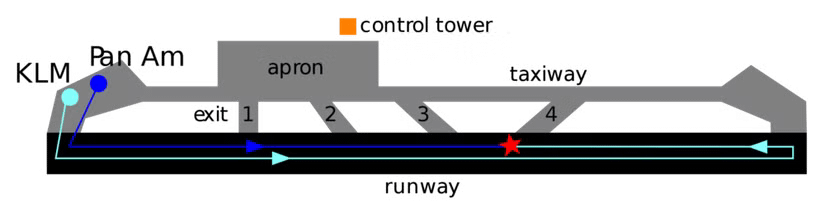
Suddenly, the pilots could no longer see each other. The air traffic controllers in the tower were also completely blind to the runway.
At the time, Los Rodeos lacked ground radar technology. Everyone was completely dependent on radio communication and precise timing to know where the massive planes were located in the thick whiteout conditions.
The Real Trigger Was Miscommunication On The Radio
The most critical moment happened over the radio. Unclear and non standard phrases created deadly confusion between the pilots and the tower.
The KLM captain transmitted a message stating they were at takeoff. The control tower misunderstood this as a simple position update, not an announcement of movement.
At that exact second, the Pan Am crew radioed to say they were still taxiing down the runway. Because both crews pressed their microphone buttons at the same time, the radio signals overlapped and cancelled each other out. This technological quirk is known as a heterodyne.
Instead of a vital warning, the KLM crew only heard a loud three second blast of static. They never heard the warning that Pan Am was still in their path. Both crews firmly believed they were doing exactly what they were told.
Human Factors Like Authority Assumptions And Pressure
The dynamics inside the cockpit made a bad situation much worse. The KLM captain, Jacob Veldhuyzen van Zanten, was a highly senior and deeply respected instructor. He was literally the face of the airline, featured in their magazine advertisements and promotional materials.
Because of his celebrity status within the company, the strict cockpit hierarchy likely discouraged the junior pilots from challenging his decisions.
The flight engineer did briefly raise a concern about whether the runway was clear, but his question was quickly brushed aside by the confident captain.
Add in the mounting time pressure from strict flight duty limits. The Netherlands had just passed a law stating pilots would lose their licenses if they flew over their hours. If the KLM crew did not leave immediately, they would be grounded in Tenerife, causing a logistical nightmare for the airline. This intense pressure gave the crew a severe case of getting home, pushing them into a fatal decision.
The Collision In The Final Seconds
Believing he had full clearance, the KLM captain pushed the throttles forward. He accelerated his heavy aircraft straight down the foggy runway while the Pan Am jet was still taxiing ahead.
Because of the thick fog, the Pan Am crew only saw the KLM landing lights piercing through the mist mere seconds before impact. Pan Am Captain Victor Grubbs yelled and desperately shoved his throttles to maximum power, trying to drive his massive aircraft completely off the runway and into the grass.
Simultaneously, the KLM captain realised his mistake. He desperately pulled back on the controls for an early liftoff, pulling the nose up so violently that the tail of his aircraft scraped along the runway for twenty metres, sending sparks flying.
But his aircraft was completely full of fuel and simply too heavy to clear the Pan Am jet. The planes collided at high speed, resulting in a massive explosion. The fog was so thick that when rescue crews initially rushed to the fire, they did not even realise a second aircraft was involved until minutes later.

Why It Was A Chain Reaction And Not One Mistake
The Tenerife disaster proves that major accidents rarely happen because of one bad choice. Instead, they require a specific sequence of events to align perfectly.
- Multiple Failures Several small issues, like the initial bomb threat, the denied holding pattern, and the crowded taxiway, happened at the exact same time.
- Communication Breakdown Ambiguous language and a perfectly timed radio interference stopped the crews from sharing their actual locations.
- Environmental Conditions The dense mountain fog completely removed the safety net of visual confirmation.
- Human Factors Personal assumptions, a rigid hierarchy, and extreme legal time pressures pushed the pilots to act hastily.
No single factor alone would have caused the crash.
What Changed After Tenerife
The tragic loss of life on that runway completely changed how the global aviation industry operates.
- Standardized Phraseology Clear terms became mandatory. Pilots cannot say the word takeoff unless they are actively receiving or confirming their final departure clearance. They must use the word departure at all other times.
- Crew Resource Management Airlines introduced a revolutionary training program called CRM. This specifically trains captains to listen to their crew and requires junior officers to speak up and challenge errors within the cockpit, regardless of rank.
- Improved Airport Systems Facilities worldwide accelerated the adoption of ground radar and created much safer taxi procedures to separate moving aircraft.
- Global Impact Tenerife became a permanent turning point, setting the safety standards that protect us today.
The Lasting Impact Of The Tenerife Disaster
The Tenerife airport disaster was a tragic combination of human error, radio miscommunication, and severe environmental conditions.
While the loss of 583 lives was absolutely devastating, the lessons learned from the wreckage completely reshaped aviation safety worldwide.
By understanding exactly how these specific failures linked together, the aviation industry developed robust, foolproof safety systems. Those systems continue to protect millions of passengers and prevent similar tragedies from ever happening again.

Hi, I’m Bruno. I’ve worked in the aviation industry for over 6 years as a B1.1 Licensed Aircraft Maintenance Engineer. This blog is where I share insights on aviation and travel globally.