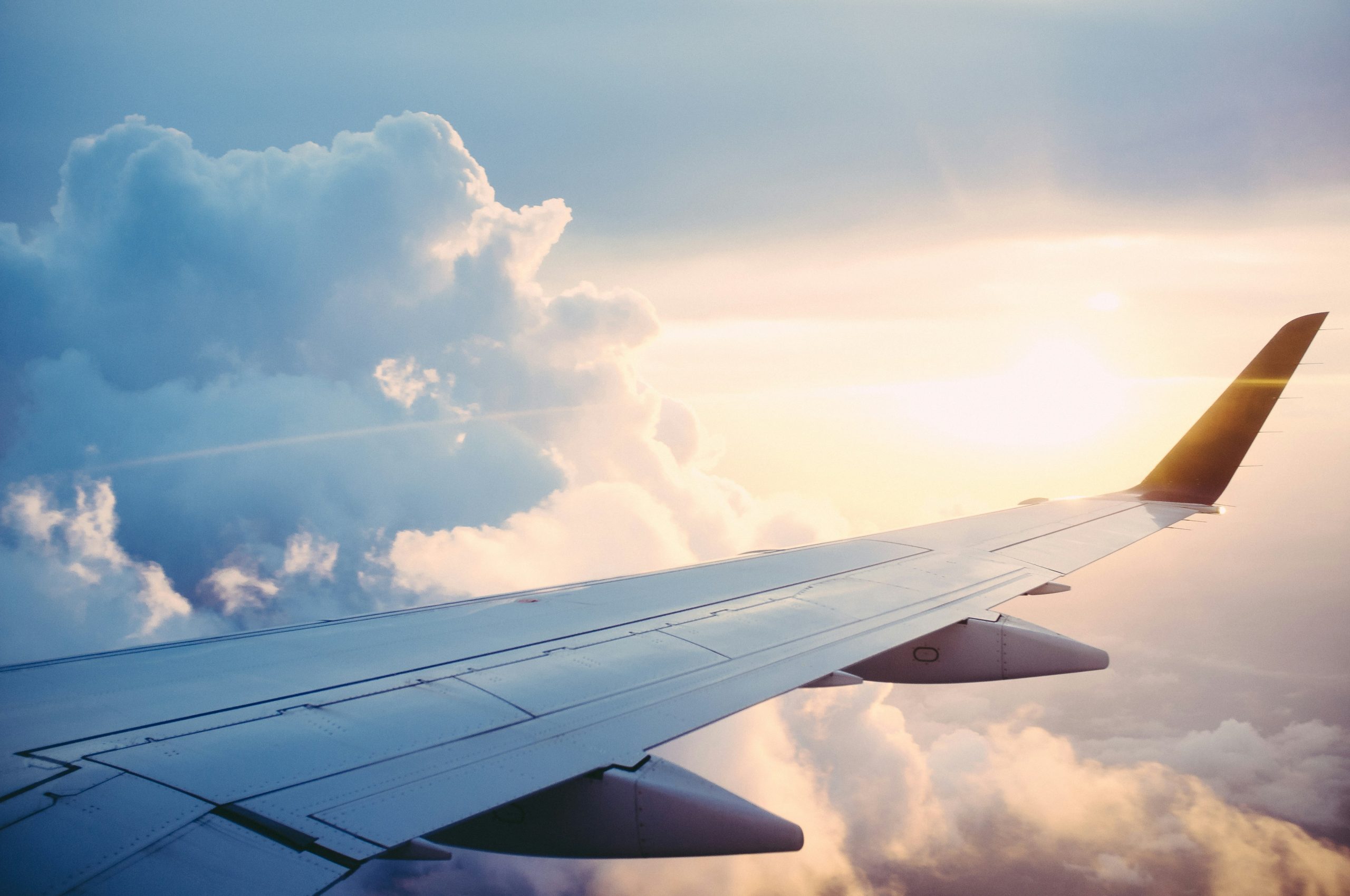
The coffin corner is the altitude where an aircraft’s slowest safe speed and its fastest safe speed meet. As a jet climbs, the speed at which its wing stalls creeps up while its maximum speed (set by the speed of sound) creeps down. Near the top of the aircraft’s envelope, the gap between “too slow” and “too fast” can shrink to just a few knots. Fly slower and the wing stalls; fly faster and shock waves form on the wing and the aircraft shakes, or buffets, and can become hard to control.
The FAA calls it the “Q-corner or coffin corner.” Its textbook example is the Lockheed U-2 spy plane, whose 1968 flight manual gave a margin as small as about 5 knots at operating altitude.
You won’t find your airliner flying in the true coffin corner. Airliner computers set the maximum cruise altitude low enough that the aircraft can still pull about 1.3 g, roughly a 40° bank, before buffet starts. The rest of this guide explains why the corner exists, what shrinks the safety margin, which accidents are wrongly blamed on it, and why passengers don’t need to worry about it.
Why does the coffin corner happen?
The coffin corner happens because two speed limits move in opposite directions as an aircraft climbs, and at some altitude they meet.
The stall speed goes up
A wing makes lift from the air flowing over it. An aircraft of a given weight stalls at roughly the same speed on its airspeed indicator at any altitude. That reading, called indicated airspeed, measures how hard the air is pushing on the aircraft.
The air gets much thinner as you climb. At 18,000 feet it is about half as dense as at sea level, and at airliner cruise levels (35,000–41,000 feet) it is less than a quarter as dense. To get the same push from thin air, the aircraft has to move through it much faster. So the true speed at which the wing stalls keeps rising with altitude.
The maximum speed goes down
Jets are limited by Mach number, their speed as a fraction of the speed of sound. Above a certain Mach number, air speeding over the curved top of the wing goes supersonic. Shock waves form, the airflow separates, and the aircraft starts to shake. This is called Mach buffet. Some aircraft also pitch nose-down, an effect known as Mach tuck.
The speed of sound depends on temperature, and the air gets colder as you climb. It falls from about 661 knots at sea level to about 574 knots at the tropopause (around 36,000 feet). So the aircraft’s Mach limit equals a lower and lower true speed the higher it goes.
Where the two lines meet
On a chart of altitude against speed, the stall line leans one way and the Mach line leans the other. The point where they cross is the aircraft’s aerodynamic ceiling, the true coffin corner. There is no speed left at which the aircraft can fly level.
The effect is stronger than the simple picture suggests. A Canadian flight test on a business jet found the wing started to buffet at about 16.8° angle of attack near 13,000 feet, but at only 6.95° at 45,000 feet. At high Mach numbers the wing tolerates far less nose-up angle before trouble starts.
Coffin corner vs service ceiling
These two ideas are often mixed up:
- Service ceiling is about engine power. It is the altitude where the aircraft can only climb at 100 feet per minute.
- Coffin corner is about the wing. It is where the stall and Mach limits meet, whatever the engines can do.
Most airliners run out of engine thrust before they ever reach the aerodynamic coffin corner. The name is also used loosely for the region just below that point, where the speed band has become dangerously narrow.
What makes the coffin corner margin smaller?
Anything that asks the wing for more lift makes the safe speed band narrower. The FAA puts it plainly: “increasing either gross weight or load factor… will increase the low-speed buffet and decrease Mach buffet speeds.”
Weight
A heavier aircraft needs more lift, so it stalls at a higher speed. This is why airliners often climb in steps during long flights. They start lower when full of fuel and move higher as they burn it off.
Turns and g-force
In a level turn, the wing has to hold up the aircraft and also pull it around the corner. That extra load is measured in g. The steeper the bank, the higher the g, and the higher the stall speed:
| Bank angle | Load on the wing | Stall speed rises by |
|---|---|---|
| 15° | 1.04 g | about 2% |
| 30° | 1.15 g | about 7.5% |
| 40° | 1.31 g | about 14% |
| 45° | 1.41 g | about 19% |
The FAA gives an example of how quickly this bites. A typical jet at 51,000 feet might have a safe band from Mach 0.60 to Mach 0.82 in straight, level flight. Pull just 1.4 g, and it will buffet even at its normal cruise speed of Mach 0.73.
A turn also slows the inner wing and speeds up the outer one. Near the corner, one wing can be heading toward a stall while the other heads toward Mach buffet.
Turbulence
A strong gust has the same effect as a sudden pull on the controls. It adds g-force for a moment, which can push an aircraft flying close to its limits into buffet or a stall warning.
Warm air
Warmer-than-normal air at altitude hurts in two ways. It cuts the thrust the engines can make, and it lowers the aircraft’s maximum usable altitude. Turning on engine anti-ice takes air from the engines and cuts thrust further.
Do airliners fly in the coffin corner?
No. Modern airliners are designed and operated to stay well below the true coffin corner. Their flight computers work out a maximum altitude for every flight and keep a deliberate safety margin.
Maximum altitude is the lowest of three ceilings
The aircraft’s flight management system picks the lowest of:
- The certified ceiling, usually set by the pressurised cabin’s design limit.
- The thrust limit, the highest altitude where the engines can still give a small rate of climb.
- The buffet limit, the highest altitude where the aircraft can still pull about 1.3 g (roughly a 40° bank) before the wing starts to buffet.
Airbus calls the result REC MAX (recommended maximum altitude). Boeing calls it MAX ALT and marks it “B” when buffet is the limit or “T” when thrust is. The figure changes with weight and outside temperature, so a heavy aircraft on a hot day gets a lower ceiling.
The 1.3 g margin is an industry convention, not one fixed legal number. Airbus describes it as a certification requirement. The US rule (14 CFR 25.251) only requires manufacturers to map out where buffet begins, and older industry training material gives 1.2 g as the US basis.
How pilots see the margin
Pilots don’t need a chart to watch the margin. The speed tape on their main flight display shows it directly:
- On Boeing aircraft, an amber band at the bottom of the speed tape marks the speed that leaves a 1.3 g margin to low-speed buffet.
- On Airbus aircraft, the speed tape shows the lowest selectable speed (VLS) and a red-and-black band at the top for the maximum speed.
- Business jet pilots also use buffet boundary charts from the flight manual. On a Gulfstream G450 at 45,000 feet, for example, the band runs from about Mach 0.65 to Mach 0.874.
Computer protection on Airbus jets
Airbus fly-by-wire aircraft add another layer of protection. In normal operation, the flight controls will not let the pilot raise the nose beyond mild buffet at high Mach, even with the stick pulled fully back. That protection switches off if key sensors fail, which is what happened on Air France 447.
Why the topic matters more today
Airliners now cruise higher than they used to. Reduced Vertical Separation Minimum rules (RVSM) opened more flight levels between 29,000 and 41,000 feet, and newer jets are more efficient up there. EUROCONTROL found that the share of European flights asking to cruise above 35,000 feet rose from 6% in 1995 to 40% in 2021. The most-requested level moved from 33,000 to 38,000 feet. More flying near the ceiling means the margins matter more.
Has the coffin corner caused plane crashes?
Rarely, if ever, in the strict sense. Several famous accidents are often blamed on the “coffin corner” online. The official investigations tell a different story. In each case the aircraft ran out of engine power or was mishandled near its ceiling. None was trapped between a stall and Mach buffet.
The U-2: the aircraft that lived in the corner
The Lockheed U-2 spy plane is the real coffin corner aircraft. It cruised above 70,000 feet, where its 1968 flight manual gave a gap of as little as 5 knots between stall buffet and Mach buffet. Pilots held that narrow band for missions of nine hours or more, often by hand or with an unreliable autopilot. Even so, no source we found links a specific U-2 loss to a coffin corner stall or overspeed.
Airliner accidents often linked to the coffin corner
| Accident | What happened | What investigators found |
|---|---|---|
| Pinnacle Airlines 3701, CRJ-200, 2004 | With no passengers, the crew climbed to 41,000 feet “to have fun” in a climb mode that lets speed decay. Speed fell to 163 knots, the aircraft stalled, and both engines flamed out. | Thrust ran out at about Mach 0.57, far from Mach buffet. The NTSB blamed unprofessional behaviour and poor airmanship. |
| West Caribbean 708, MD-82, 2005 | A heavy aircraft with anti-ice on flew at 33,000 feet, above its roughly 31,900-foot limit. The autopilot kept raising the nose until it stalled. 160 people died. | A thrust-limited stall made worse by the crew misreading the situation. |
| Air France 447, A330, 2009 | Iced-up speed sensors switched off the autopilot. Sustained nose-up inputs took it from 35,000 to about 38,000 feet into a stall it never recovered from. | It began with unreliable airspeed readings and handling errors, not a closing speed band. |
| China Airlines 006, 747SP, 1985 | An engine failed at 41,000 feet. Speed decayed under autopilot and the aircraft rolled over and dived about 30,000 feet. It landed safely. | Thrust loss and over-reliance on the autopilot. |
These accidents still teach the core lesson of the coffin corner: margins at cruise altitude are thin. On AF447, a climb of only about 3,000 feet was enough to stall the aircraft.
The closest recent example of the real two-sided squeeze involved a South African Airways A340-600 in 2018, near 40,000 feet over Switzerland. A wind change pushed it over its maximum speed. The captain disconnected the autopilot and pitched up, and the aircraft reached its maximum angle of attack several times with stall warnings. The German investigator BFU, which published its report in 2023, pointed to gaps in crew training. The aircraft landed safely.
How do pilots avoid the coffin corner?
The main defence is to protect the margin so a recovery is never needed. Standard airline practice includes:
- Treat REC MAX or MAX ALT as a limit, not a target. Crews often cruise a little lower, especially when turbulence is forecast.
- Keep turns gentle. At cruise altitude pilots normally limit bank to about 10–15°.
- Avoid climbing in vertical-speed mode near the ceiling. That mode holds a climb rate and lets speed bleed away, which is exactly what happened on Pinnacle 3701.
- Don’t chase the airspeed in turbulence. Pilots hold attitude and accept small speed swings instead of making big control inputs.
- If speed starts to drop, act early. Level the wings, add thrust and descend.
What happens if an airliner stalls at high altitude?
Training changed after Pinnacle 3701 and the 2009 Colgan Air 3407 crash. Pilots used to be taught to power out of a stall with minimum height loss. In 2010, US law (Public Law 111-216) led to a 2013 FAA rule requiring full-flight-simulator training in upset recovery, manual slow flight and stall recovery. Airlines had until March 2019 to comply.
The FAA’s stall training guidance now names the coffin corner directly as a place with “lower margins for stall onset and recovery.” It says “reduction of AOA must precede any increase of thrust.” In plain terms, lower the nose first. It also warns that “at high altitudes, stall recovery will likely require losing several thousand feet.” Lowering the nose and giving up altitude is the only reliable way out, which is why prevention matters so much.
Should passengers worry about the coffin corner?
No. The coffin corner sounds alarming, but on a normal airline flight you are thousands of feet below it with a built-in safety margin. The flight computers calculate that margin for your exact weight and the outside temperature, and the pilots see it on their displays the whole time. Pilots train for high-altitude upsets in the simulator, and high-altitude stalls in airliners are extremely rare. If you feel the aircraft shake in cruise, it is almost certainly ordinary turbulence, not Mach buffet.
Coffin corner FAQ
Why is it called the coffin corner?
It is pilot slang for the corner of the flight envelope chart where the stall line and the Mach line meet. Leaving the narrow band in either direction can mean losing control. No reliable source records who first used the term.
What is the Q corner?
“Q corner” is another name for the coffin corner, used by the FAA. The Q is widely said to stand for dynamic pressure, which engineers write as q.
At what altitude is the coffin corner?
It depends on the aircraft, its weight and the air temperature. For the U-2 it was above 70,000 feet. For a Gulfstream G450 business jet it is around 55,000 feet. Airliners are capped well below theirs by the flight computer’s maximum altitude, which changes with weight and temperature on every flight.
What is Mach buffet?
Mach buffet is shaking caused by shock waves forming on the wing when the airflow over it becomes supersonic. It marks the high-speed edge of the coffin corner.
What is low-speed buffet?
Low-speed buffet is the shaking that comes just before a stall, when air starts to break away from the wing. It marks the slow edge of the coffin corner.
Is the coffin corner the same as the service ceiling?
No. The service ceiling is set by engine power: the height where the aircraft can barely climb. The coffin corner is set by the wing: the height where the stall and Mach limits meet.
Can a coffin corner stall be recovered?
Yes, by lowering the nose to reduce the wing’s angle of attack, then adding power. At high altitude this usually costs several thousand feet.

Hi, I’m Bruno. I’ve worked in the aviation industry for over 6 years as a B1.1 Licensed Aircraft Maintenance Engineer. This blog is where I share insights on aviation and travel globally.